Showing posts with label microscopes. Show all posts

Wednesday, December 29, 2010

General Science: Pond water: More than meets the eye

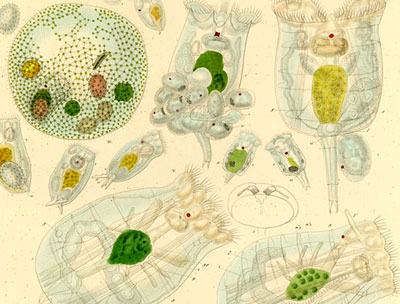
This week the kids hunted for microorganisms in a sample of pond water taken from Robert and Karen Clements' pond (thanks once again for your annual donation of pond scum!).

To get a sense of what we were looking for, we started off by watching a few short video clips of different microorganisms. Then the kids prepared their slides, making sure to get a sample of pond water that was nice and goopy. After hunting around a bit, the kids turned up some interesting single-celled organisms and even a worm or two. Believe me when I tell you, these 2 mm guys are pretty alarming swimming around eating algae magnified 100x!

Tuesday, December 21, 2010

Biology: 10,000 Microns under the Sea

This week the kids hunted for microorganisms in a sample of pond water taken from Robert and Karen Clements' pond (thanks once again for your annual donation of pond scum!).

The kids turned up some interesting single-celled organisms and even a worm or two. Believe me when I tell you, these 2 mm guys are pretty alarming swimming around eating algae magnified 100x!

The kids used what they learned last week to estimate the sizes of the different organisms.

Wednesday, December 15, 2010

Biology: How small is small?

This week we learned a technique for measuring specimens under the microscope. The kids measured the lengths of ants and even actual cells. You can be sure we weren't measuring in meters or even centimeters. The kids got some practice with micrometers, 1000 of which make a millimeter.

How did we do this? Using a ruler, the kids measured the field of view. Then they converted this number to micrometers (so much easier to work with when you're measuring cells and such). They estimated how many times a specimen would fit within the field of view, did some simple math and came up with a measurement that was within 100 micrometers (.1mm of the accepted answer). Not bad for a day's work!

Physics: What color is it really?

This week we did 3 mini-experiments to investigate how we perceive color. The first was with spinning color wheels. The kids compared the patterns of the discs when still to the patterns they saw when the discs were spun. The second mini-experiment involved looking at magazine pictures under the microscope and comparing the images seen with the naked eye to the colors seen at greater magnification. The third was simply giving each kid some red, blue, and yellow paint and letting them go wild...well on paper anyway.

When we physically combine red, blue, and yellow paints in different proportions we can create an enormous range of colors. Similarly the human brain will combine colors that your eyes see when those 2 colors are seen in rapid succession, as in the case of the spinning color wheels or when they are placed very close together, as revealed by a microscopic examination of pictures from a magazine. What is especially cool about the magazine pictures is that no matter what color you "see," when examined under the microscope you realize that the image is made up of just 3 colors: magenta, cyan, and yellow (aka red, blue, and yellow). By producing images that include different ratios of the primary colors, you can get just about any color.