Showing posts with label general science 10-11. Show all posts

Friday, June 24, 2011

General Science and Physics: Dry Ice

Dry ice is unlike the ice we know and love. It's frozen carbon dioxide, and it's called "dry" because it passes from the solid phase directly into the gas phase, skipping the liquid phase entirely, resulting in some AWESOMELY weird and funky behaviors! It's CRAZY-cold, so cold in fact, we only handled the dry ice with a towel or tweezers....NEVER with our bare hands!

We demonstrated its COOLNESS in the following ways...
  • compared "dry ice" to regular "wet ice"
  • produced a lot of spooky fog.
  • "poured" carbon dioxide gas into a cup on a scale and noted that it weighed more than an equal volume of air.
  • used carbon dioxide gas as a fire extinguisher (Don't panic, the fire was a single lit candle).
  • made long-lasting carbon dioxide bubbles by adding dry ice to soap solution.
  • made the dry ice "squeal" and vibrate after pressing it with a metal spoon.
  • inflated a balloon by putting a piece of dry ice inside and then tying off the open end.
The COOLEST thing we did was toasting a fantastic year of science with home-brewed soda.
Here's the recipe:
1. Pour juice into a pitcher
2. Add a block of dry ice
3. Enjoy the show as you down your cold, carbonated fruit-flavored soda!


Monday, June 13, 2011

Science Fair

General Science:
Market Research Projects.Which ______ is the ______est?

In these projects the kids were challenged to compare everyday objects through the lens of scientific evaluation. To determine which object was the best for a particular category the kids had to define best in some way that could be measured and then set up conditions that allowed for a fair competition. This is the method used by all scientists regardless of their questions.

Physics: Inventors Workshop

Over the past few weeks the kids have attempted to design and build an invention that contains a lever. We agreed up front that it was unlikely that any of our inventions would succeed in the traditional sense of the word. After all, most inventors spend thousands of hours imagining, designing, building, failing, and restarting the process again and again. When you look at these projects, you should see them as a sort of diary of the kids dreams and their initial attempts to actualize them. Trial and error plays a role in the creation of every great invention. Here is a window into this process.

Biology: Human Body Projects thanks for volunteering

Working with people is never easy. Working with human subjects even less so. Part of what we discovered this year in biology is the complexity and lack of predictability you get with all living things. Whether its microscopic organisms in pond water or human size ones in my backyard, bottom line is it takes a lot of patience, planning, and careful observation to design and carry out an experiment with human subjects. The biology kids first did their experiments on each other. After analyzing their results they modified their experiments to arrive at what you see here today.


Making ice cream with salt without making salty ice cream!

This week we did a pretty COOL trick....we made ice cream, without a freezer, using our own DIY ice cream machine. How did we do it and what does it have to do with science?

The kids poured the ice cream ingredients (milk, vanilla, and sugar) into a small plastic bag. Then they placed this bag into a larger bag filled with a lot of ice and a lot of salt. The whole business was then wrapped in a towel and then shaken until the milk mixture solidified. The rock salt caused the ice to melt quickly and reach a sub-zero temperature, so that the resulting freezing salt water could quickly absorb heat from the milk mixture, giving you yummy, delicious ice cream or at the very least, a super-cool milk shake.

Here's the procedure in case anyone wants to try it at home.

1. Pour ¼ cup of milk into a sandwich-size zip lock bag.
2. Add 1 teaspoon of sugar and a couple drops of vanilla extract.
3. Close the bag carefully, while getting rid of the extra air.
4. Mush the bag around to mix the contents.
5. Place this bag in another sandwich zip lock bag, remove the extra air, and seal.
6. Fill a 1-gallon zip lock bag with ice and a half a cup of rock salt.
7. Place the double bagged milk mixture inside the larger bag, squeeze out the extra air, and seal.
8. Wrap each bag in a towel and mix, shake, and churn until the inner bag's contents freeze.

Tips:

* Make sure all bags are closed, especially before you start shaking up the bag of ice and salt.
* Double-bagging the milk mixture is important, to help reduce the odds of salt penetrating the bag and getting into the ice cream (yuck!).
* Err on the side of too much ice and too much salt.
* Try to keep the milk mixture bag in the middle of the ice, and especially in the middle of the melted salt water.
* See what happens if you add different flavors like chocolate syrup or lemon juice.

Wednesday, May 18, 2011

Science Fair coming soon!

Haven't written an update in a while, because as of May my job has changed somewhat. Whereas I uses to design the experiments, now the kids have taken over, and I have become their humble lab assistant, here to provide space and materials for the experiments they are designing themselves. These projects will be on display at this year's Science Fair. It will take place June 7th (Erev Shavuot) at my house from 10:00-11:30. Family and friends are welcome!

Here's a preview of what to expect.

General Science: Product Testing/Market Research…
"Which _____ is the _____est"
Find out the answers to questions such as which toothpaste is the best, which cream whips up the most, which permanent marker is the hardest to remove, and which type of soda makes the best mentos explosion!

Physics: Lever-based Inventions...
"Give me a place to stand, I will move the Earth"
Get a rare view of cutting edge technology at various stages of development.

Biology: Carrying out Experiments in REAL TIME…
You and yours get the chance to be subjects in these experiments on the human body.

See you there!
Rebecca

Wednesday, April 6, 2011

General Science: What to feed your pet yeast

Before we do away with all of our חמץ, it seems appropriate to learn something about our tiny unicellular fungal friend, the yeast. After all, we have a lot in common: Like us, yeast eat, reproduce, and respire. That's fancy-talk for releasing carbon dioxide as a result of transforming the energy from food into energy our cells can use. This comes in handy when baking bread. It's the carbon dioxide gas that causes the bread to rise.

This week's question was: What's a yeast's favorite food: salt, sugar, or flour? To know which food was eaten most heartily by our yeast, we prepared bottles of yeast, warm water, and one of the three foods being tested. We covered each bottle with a balloon and then sat back and watched the show. The samples of yeast fed sugar were the happiest, i.e. the balloons inflated the fastest because of the greater production of carbon dioxide. Flour came in second and salt came in last. We discussed how flour, a complex sugar, gets broken down into simpler sugars. A little more work, but when you're hungry, you do what you have to. Yet one more thing we all have in common...LAZINESS and an appreciation for fast food.

Friday, March 25, 2011

General Science: Chemistry in a bag

The kids started off with calcium chloride, sodium bicarbonate (see if your kids remember this compound's common name...it's baking soda), water, and phenol red, an indicator for acids. They put all of these materials in a plastic bag, the catch being that the liquids (water and phenol red) were first poured into plastic cups, which themselves were carefully placed in the bag. Why all the extra steps? This allowed us to measure the whole business BEFORE the chemical reactions began. After tying off the bag, the kids allowed the powders and liquids to mix, and that's when things got exciting! The kids observed many changes including: bubbles, the bag inflating, the red liquid turning yellow, and the contents both heating up and cooling down. The kids then measured the weight of the bag with its contents, and they were pretty surprised to find very little if any change. That's conservation of mass for ya! Step 2 of this experiment was breaking down the reaction into parts to see what happens when you combine different pairs of ingredients.

Friday, March 18, 2011

General Science and Biology: Making Crystals

This week we continued our investigations of solutions by making and examining crystals under the microscope. First we made saturated solutions of salt, copper sulfate, and borax. Then we placed a drop of each on a microscope slide, put them outside and waited for them to evaporate, and then used a microscope to look at the crystals that remained.

Pretty cool, but not nearly as cool as the rock candy we prepared. On paper, a very simple operation: Make a really saturated solution of sugar water (3:1) ratio. Heat it on the stove. Then pour it into a jar that has a string suspended inside. Wait a week, and voilà, you've got rock candy. In practice though, it's very messy, sticky, with an extremely low yield. We observed that using a pipe cleaner will produce better crystals because of the increased surface area, but then you might also get brightly colored crystals that not so mysteriously match the color of the pipe-cleaner.

Wednesday, March 9, 2011

General Science and Biology: Solutions

This week we learned about solutions, that is liquid mixtures. In particular we wanted to know whether water temperature affects how well something dissolves. First the kids compared the time it takes to dissolve a couple drops of food coloring in different water temperatures. Then they tried to see how much sugar they could stir into solution, once again comparing different water temperatures. They concluded that hot water is much more effective at dissolving solutes (that's fancy-talk for stuff).

In the biology group we also noted that the final volume of the sugar solution was surprisingly LESS than the sum of the initial water volume plus the sugar. Part of what happens when you dissolve something is that it reacts chemically with the solvent (fancy-talk for liquid) and/or fits into the spaces within the molecules themselves.

Thursday, March 3, 2011

General Science: Plop plop fizz fizz...

This week we wrapped up our unit on acids and bases by comparing the strengths of three different brands of antacids: Tums, Gaviscon, and Rennie. We began by talking about the role hydrochloric acid plays in the stomach and how antacids treat indigestion by neutralizing this acid when it backs up up into your esophagus.

To test which brand works best the kids ground up each antacid pill into a fine powder, dissolved it in warm water, and then added it to a test tube of vinegar (our stand in for hydrochloric acid). After waiting a minute, they measured the pH. They concluded that the antacid that resulted in the pH closest to 7 was best at neutralizing the acid.

Along the way we noted several sources of error including not using pills of the same size, losing pieces of the pills as they were being ground up, and the water temperature being variable. We also made an exciting unexpected observation. Turns out that in addition to producing an acid-base reaction, adding Gaviscon solution to vinegar leaves you with an awesome slimy gel-like solid. For your average 4th grader that's up there with the inadvertent discovery of antibiotics.

General Science and Physics: The Shadow Knows

This week we observed what happens to outdoor shadows produced by the sun over time. The kids worked in pairs repeatedly tracing each other's shadows, however always from the same starting position. We were all pretty surprised to see that even over a short period of time, in the late afternoon our shadows grew and changed in position.

In physics we took this one step further and used what we learned to make sundials. We built them out of straws mounted on plates. The kids brought them home and set them up in spots that get a lot of sun, so that they will be able to trace the straw's shadow at different times over the course of the day.

Sunday, February 20, 2011

General Science and Biology: Butterfly Season

Over the past few weeks the kids have been creating butterflies that are camouflaged in different areas of my house. For each one we recorded the date the butterfly went up on the wall, its birthday and the day it was observed by one of my kids i.e. the day of its death.

Check out some of the most well-adapted ones!

Wednesday, February 16, 2011

General Science and Biology: Purple cabbage broth...more than just just smelly and blue

This week we boiled up some purple cabbage. Why did we do this? Well, it wasn't simply to overwhelm our senses with its powerful smell and uncanny blue color. Cabbage broth has the interesting property of indicating for acids and bases.
The kids added cabbage juice to 7 different liquids and observed the results. They recorded the color changes and using their data from last week, ordered the cups according the pH values. They observed that cabbage juice indicates strong acids with pinks, weak acids with purples, neutrals with blues, weak bases with greens, and strong bases with yellows. Finally they were given an unknown liquid, and using their cabbage-pH scale they guessed its pH.

In the Biology group we took the analysis one step further. After measuring each liquid's pH with the cabbage juice indicator, we explored what happens to the pH of an acid as we add increasing amounts of a base. The kids started off with vinegar + cabbage juice, giving them a nice bright pink, indicating a pH of around 2. As they added more and more baking soda they were able to observe the vinegar change colors as its pH gradually moved closer to a neutral 7.


Friday, February 11, 2011

Biology and General Science

This week we learned about acids and bases and three types of indicators you can use to identify them. We began by using red and blue litmus paper to test different household liquids. We were then able to classify them as acids, bases, or neutral. However while litmus paper is useful, it doesn't tell you anything about how strong or weak a base or acid is. So, for example, while baking soda and bleach, the two bases we encountered, score the same on a litmus test, baking soda tastes mildly bitter whereas tasting bleach will land you in the hospital (hypothetically speaking, of course!). We observed that in order to appreciate this without landing in the hospital, pH paper comes in real handy.

Thursday, February 3, 2011

General Science: The Case of the Stolen Handouts

There were no two ways about it. I took her call 'cause I needed the money. The case was dirtier than a first grader's backpack and twice as heavy. The broad that hired me told me a couple a thugs stole some paper, and I ain't talking about the kind with dollar signs. Some handouts on "Why does salt taste so darn good?" Only clues I had were four sets of prints and a pile of white powder.

Called in a favor with a buddy of mine downtown and he ran the prints and came up with a list of suspects with records so clean you could eat off of them. Two teachers: Tammy Lefcourt and Devra Lehman, Asaf, the owner of the local toy store, and the damsel in distress herself, Rebecca Perlin. Each one had his own peculiar attraction to a specific white powder. Tammy and her baking powder; Devra, corn starch; Asaf, sugar; and Rebecca, salt.


I let the boys in the lab take a crack at it. They tested the powder with more chemicals than you'd find in a package of Osem soup nuts. Then they looked at it under the microscope and checked if it could conduct electricity.
They compared the results to some similar cases they had a while back, and the answer was clear as day.

That science teacher must have thought I was some chump – turned out she was right. It was her and that other broad, the English teacher. One was in it for the thrill the other for the spelling mistakes. Me, I had bigger fish to fry.

Wednesday, January 26, 2011

General Science: Let your fingers do the talking

This week the kids learned about fingerprints, you know...dactyloscopy. They used graphite from their pencils and transparent tape to record each of their fingerprints. Then we looked at some common patterns and used these to classify them. Finally the kids produced a single "mystery" print which their partners were challenged to identify using the database of labeled fingerprints.

Tuesday, January 11, 2011

General Science and Biology: Which chip is the greasiest?

This week in science we asked the following questions: which brand of potato chip is the greasiest and more importantly, how can I be sure?

We went about answering them by carrying out 3 tests. The first 2 were a touch and a taste test in which the kids rated the chips on a scale from 1-5, with 5 being the greasiest. Then the kids were challenged to come up with a more quantitative test, one based on measurement. Some kids crushed equal amounts of each chip on a piece of graph paper and then compared the sizes of the different oil stains. Others compared the weight of the chips before and after crushing; the assumption being, the greasier the chip, the more oil lost in the act of being crushed on a piece of paper. Another test consisted of soaking different chips in water, removing them, and then comparing the amount of oil observed sitting on top of the water.

After carrying out our tests, we tested our tests. We read the nutritional information on the packages and reviewed our data to see which test was actually the best. Finally the kids thought about how they could improve their tests in the future.


Friday, January 7, 2011

General Science: Observations of different white powders

This week we continued our exploration of physical and chemical properties by investigating 4 different white powders: sugar, salt, potato starch, and baking soda. The physical properties we investigated included: how each one looks under the microscope and how each one feels. As for chemical properties, we combined the powders with with vinegar and iodine and recorded the results. Finally we looked at whether any of the powders conduct electricity when dissolved in water.

The kids now have a comprehensive data sheet on these substances and their physical and chemical properties. If by chance, they should come into contact with some unknown white powder, making an identification should be a piece of cake!

One never knows when these skills and/or data might come in handy...

Wednesday, December 29, 2010

General Science: Pond water: More than meets the eye

This week the kids hunted for microorganisms in a sample of pond water taken from Robert and Karen Clements' pond (thanks once again for your annual donation of pond scum!).

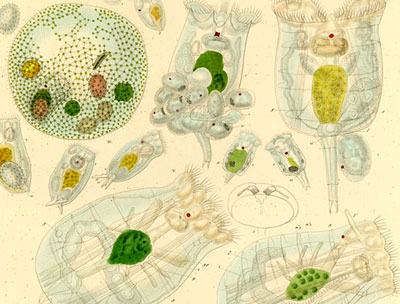
To get a sense of what we were looking for, we started off by watching a few short video clips of different microorganisms. Then the kids prepared their slides, making sure to get a sample of pond water that was nice and goopy. After hunting around a bit, the kids turned up some interesting single-celled organisms and even a worm or two. Believe me when I tell you, these 2 mm guys are pretty alarming swimming around eating algae magnified 100x!

Tuesday, December 21, 2010

General Science: The Right Stuff

This week the kids had to design a spacesuit that could withstand the intensely high temperatures one might find on Venus. Lacking the funding to actually travel to Venus and not wanting to violate the Helsinki Declaration (ethical principles for research on human subjects), we used ice-pops instead of people and hot water instead of Venus. The kids made spacesuits using one of three available materials: tin foil, cotton balls, and bubble wrap. Each of the subjects was then placed in a plastic bag and then then submerged in hot water for 1 minute. Afterward, the kids opened up each ice-pop and measured how much of it had melted by pouring the liquid from each one into a graduated cylinder.

Wednesday, December 1, 2010

General Science: Iodine the indicator


This week the kids learned how to use an INDICATOR, a compound that changes color when it comes in contact with a particular substance. The kids were given around 10 different foods to test using iodine, an indicator that changes from orange to black on contact with starch. As they made their way through the food samples (testing them, not eating them), they were able to refine guesses about what starches have in common. Finally, we concluded that starches come from plants and are how plants store simple sugars.

Afterward we discussed how simple sugars are connected by chemical bonds to make complex sugars and conversely, how the chemical bonds within complex sugars are broken to produce simple sugars. Try chewing on a cracker for a few minutes (works best with unsalted ones), and you'll notice a sweet taste in your mouth that results from your saliva breaking down the starch into simple sugars.